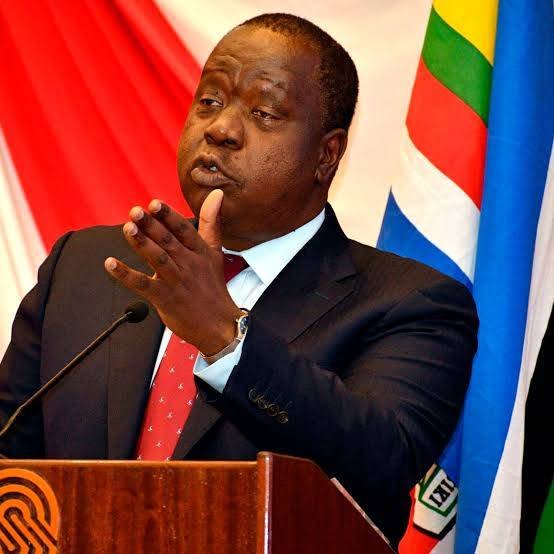
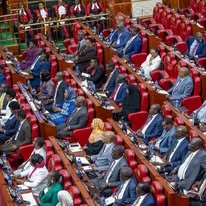
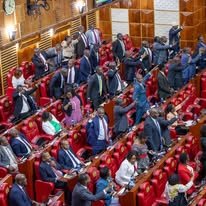
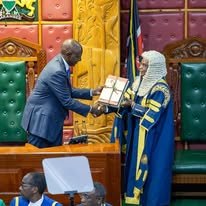
On 20 November 2025, President William Ruto addressed a special joint sitting of both the National Assembly and the Senate for his 13th State of the Nation Address. His message was clear, bold, and deeply rooted in a vision of economic self-reliance. Rather than depending on foreign aid or piling up debt, Ruto insisted Kenya must grow through “our own revenues and taxes.
A Vision Woven from The Ground Up
In his speech, Ruto framed Kenya’s story as one not born in boardrooms or offices, but in farms, construction sites, and community health centers. That metaphor wasn’t accidental — it underscores his narrative of a people-led transformation, grounded in everyday sacrifice, sweat, and progress. He praised the hustle of ordinary Kenyans — from digital entrepreneurs to construction workers to health workers — and positioned them as the engines of Kenya’s development.
He argued that Kenya has all the talent, resources, and spirit it needs. He even referenced the Asian Tiger economies (like Singapore, South Korea, Malaysia) as models: once-poor nations that, through deliberate choices and investments, transformed into developed economies. Ruto emphasized that Kenya’s moment to leap forward is now — and it will take “courage, clarity, and conviction.”
Fiscal Self-Reliance Over Aid
One of the most powerful points in Ruto’s address was his rejection of the aid-driven development model. He explicitly stated:
“Our country will not be developed by others. Our country will not be developed by aid. Our country will not be developed by debt. Our country will be developed by us, using our own revenues and taxes.
He also made a bold promise regarding fiscal integrity: “no revenues or taxes will be stolen.” This is a critical commitment, especially given Kenya’s history of corruption and fiscal mismanagement. By centering his development model on domestic revenue, Ruto is calling for a fundamental shift in how Kenya funds its future.
He defended this approach by pointing to rising public confidence — citing that respected economic assessors and market sentiment are now affirming a “strengthening economy” under his leadership.
Social Investments: UHC and Affordable Housing
Ruto didn’t just talk about money — he tied his vision to concrete social programs.
- Universal Health Coverage (UHC): He said that the government is paying health insurance premiums for 2.3 million vulnerable Kenyans, including orphans, widows, and the elderly, because “for them, healthcare is not a privilege. It is a right.”
- Cancer Treatment: He also announced an upgrade to the Social Health Authority’s cancer treatment support, increasing the coverage to KSh 800,000 starting December 1.
- Affordable Housing: Ruto defended his administration’s housing program, recalling how skeptics once dismissed it as impossible. But he insisted that the “foundations of progress” are real, and more housing units are now being built across Kenya.
Economic Progress: Farming, Industry & Value Chains
In his address, Ruto also highlighted clear economic gains:
- Agriculture: Cotton production has nearly tripled. Cashew nut and coconut yields are increasing.
- Livestock & Dairy: Leather exports have surged to KSh 2.5 billion. Meat exports are up 45%. Dairy production is also booming — and the government has installed 230 new milk coolers and massively scaled up animal vaccinations.
- Irrigation & Industrialization: To reduce dependence on rain-fed agriculture, Ruto pledged to massively expand irrigation. He linked this to his broader push for agro-industrialization.
- Energy: He said that power generation must grow significantly to support manufacturing, e-mobility, and Kenya’s ambitions for green industrialization.
Innovation, Research, and Export Ambitions
Ruto also talked about Kenya’s future economy, powered by innovation:
- He announced a dedicated State Department for Science, Research & Innovation to promote STEM, research, and high-level professionals.
- He wants to grow Kenya’s national research fund from 0.8% of GDP to 2%, mobilising both public and private capital to drive technological growth.
- On trade, he emphasized the need to turn Kenya into a net exporter of goods and services, particularly in agriculture, to reduce the huge import bill.
- He used Safaricom / M-Pesa as a success story — a local innovation that became a global platform — to show the kind of potential Kenya can unlock.
Risks, Criticisms, and Political Tensions
Not everyone is convinced by Ruto’s vision. A few critical voices are already rising:
- Senator Enoch Wambua, Deputy Minority Leader in the Senate, warned Ruto against introducing new taxes. He argued that Kenyans are already “overtaxed” and that another levy or fund would be too heavy a burden.
- Wambua also expressed concern about the privatization of state assets (like the Kenya Pipeline Company), warning that selling national assets to raise budget funds could backfire.
- Some analysts, like in The Standard, are skeptical — suggesting that while Ruto’s speech is visionary, it risks being “oratory without delivery” if the promised reforms don’t materialize.
Why This Speech Matters
- A Shift in Development Model: Ruto is pushing Kenya away from external borrowing toward homegrown growth. That’s a major strategic pivot.
- Social Promise + Economic Growth: By tying development to both social welfare (health, housing) and economic reform (agriculture, energy, research), he presents a holistic growth path.
- Long-Term Vision: His references to countries that became developed through deliberate choices shows he’s thinking beyond election cycles — he wants generational transformation.
- High Stakes: But, the success of this vision depends heavily on discipline, transparency, and implementation. If revenue is collected but misused, or reforms stall, the risk is real — both economically and politically.
My Analysis
Ruto’s address was ambitious but realistic. He didn’t just sell hope — he backed it with numbers, specific programs, and a narrative of ownership. However, the biggest challenge will be implementation. Collecting more domestic revenue is one thing; ensuring that money is used efficiently is another.
If his government truly delivers on irrigated agriculture, value chain growth, and innovation, Kenya could see a structural transformation — not just in GDP numbers, but in people’s lives. But if his critics are right, and the reforms are more talk than action, then the address could eventually be remembered as grand, but empty.
Conclusion: A Turning Point — But Not Without Risk
Today’s State of the Nation Address by President Ruto could be a turning point in Kenya’s history — a declaration that the country will no longer be a passive recipient of aid or a perpetual borrower. Instead, he envisions Kenya building itself: through sweat, innovation, and discipline.
That said, vision alone is not enough. For this to be more than rhetoric, the government must walk the talk. The next few months and years will be crucial: for scaling up irrigation, exporting more, funding research, and delivering social programs.
Whether Kenyans will truly hold their breath and say, “This is a Kenya built by us,” will depend on how much of this speech becomes action.
Trending Now