Protests against President Donald Trump have taken place in towns and cities across the US in a coordinated event titled “No Kings”.
On a chilly evening in mid-November, about 135 people gathered along a highway in Boone, North Carolina, a small Appalachian college town not known as a hotbed of leftist protest. They held signs reading “Nazis were just following orders too” and “Time to melt the ICE,” and chanted profane rebukes at Immigration and Customs Enforcement agents rumored to be in the area. “They came here thinking they wouldn’t be bothered,” one Appalachian State University student told The Appalachian at the impromptu rally. “Boone is a small, southern, white, mountain town. We need to let them know they’ll be bothered anywhere they go.” In a region often stereotyped as silently conservative, this flash of defiance was a startling sign that the battle lines of American politics are shifting in unexpected ways.
For the past several weeks, the Trump administration has been rolling out a mass deportation campaign of unprecedented scope — one that is now reaching deep into Appalachia. Branded “Operation Charlotte’s Web,” a deployment of hundreds of Department of Homeland Security and Border Patrol agents descended on North Carolina in mid-November, making sweeping arrests in and around Charlotte and into the state’s rural mountain counties.
Officials billed the effort as targeting the “worst of the worst” criminal aliens, but the numbers tell a different story: More than 370 people were arrested, only 44 of whom had any prior criminal record, according to DHS. The vast majority were ordinary undocumented residents — people going to work or school, not “violent criminals” — which underscores that the crackdown is less about public safety than meeting political quotas.
Indeed, Trump campaigned on conducting the largest deportation operation in U.S. history, vowing to round up 15 to 20 million people (which is more than the estimated 14 million undocumented people living in the U.S.) and pressuring ICE to triple its arrest rates to 3,000 per day. The federal dragnet has already driven ICE arrests to levels not seen in years; immigrants without criminal convictions now make up the largest share of detainees. But the administration is also facing widespread resistance to its policy of indiscriminate arrests and mass deportations, not as the exception, but as the rule — and among everyday, fed-up Americans across the country.
The demonstrations were held to counter a rare military parade hosted by Trump in Washington DC, and came after days of protests in Los Angeles and elsewhere over his immigration policies.
Lawmakers, union leaders and activists gave speeches in cities including New York, Philadelphia and Houston to crowds waving American flags and placards critical of Trump.
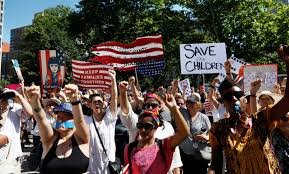
The military parade on Saturday evening, also Trump’s birthday, was timed to celebrate the 250th anniversary of the US Army. He warned that any protests at the parade would be met with “heavy force”.
Those were the words thousands of people chanted near the city’s Immigration and Customs Enforcement (ICE) field office, and throughout the streets of Manhattan Tuesday night as part of a series of nationwide rallies against President Trump’s immigration sweeps and the deployment of the U.S. military in California.
“There are many voices in my community that can’t be here today out of fear of what the administration is doing, so I want to be here for them,” 19-year-old Jeanet told NPR as she joined hundreds of other protesters in lower Manhattan Tuesday night.
Sponsor Message
She asked for her last name to not be included for fear of her safety. She said she wants to join the military, and that also played a role in her going to the protest.
“I feel like it’s more important for me, as somebody who is going to be part of the government, to voice my opinion and show that there can be people that are for the U.S., but still against what this administration is doing today,” Jeanete said.
Across the country, protesters also took to the streets in Chicago, San Francisco, and Seattle, Dallas and half a dozen other cities.
The Trump administration has vowed to arrest 3,000 migrants a day. To accomplish that goal, the Department of Homeland Security has conducted raids all across the country — from a parking lot in a Los Angeles Home Depot, to a Dominican neighborhood in Puerto Rico, to a meatpacking plant in Nebraska.
In New York City, the protest was peaceful. That’s a contrast with those in Los Angeles, where police and protesters clashed in some parts of town over the weekend sparked by immigration raids conducted by federal immigration agents.
The New York Police Department did not immediately reply to questions about how many arrests were made, but NPR reporters saw at least half a dozen people placed in handcuffs.
Sponsor Message
Paula Lopez, 66, said what’s happening is giving her flashbacks of when she was arrested by immigration agents in a New York factory in 1980.
“It hurts me to see families being separated, because I lived that,” Lopez, who came to the protest with her sister, told NPR in Spanish. “We come here to work … to progress — it’s not fair.”
Arfraz, a 43-year-old man from Queens, also remembers when decades ago ICE took away a family member. It was traumatizing, he said.
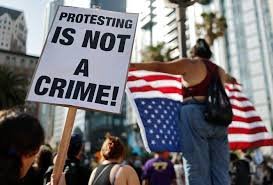
So, joining Tuesday’s protest felt important to him, especially for those he knows are scared.
“They can’t necessarily show up to rallies because they might get picked up by ICE, so I think we have to stand up,” said Arfraz, who asked NPR to not use his last name out of fear for his safety. “And those who are able to stand up have a higher and urgent responsibility to do it today.”